

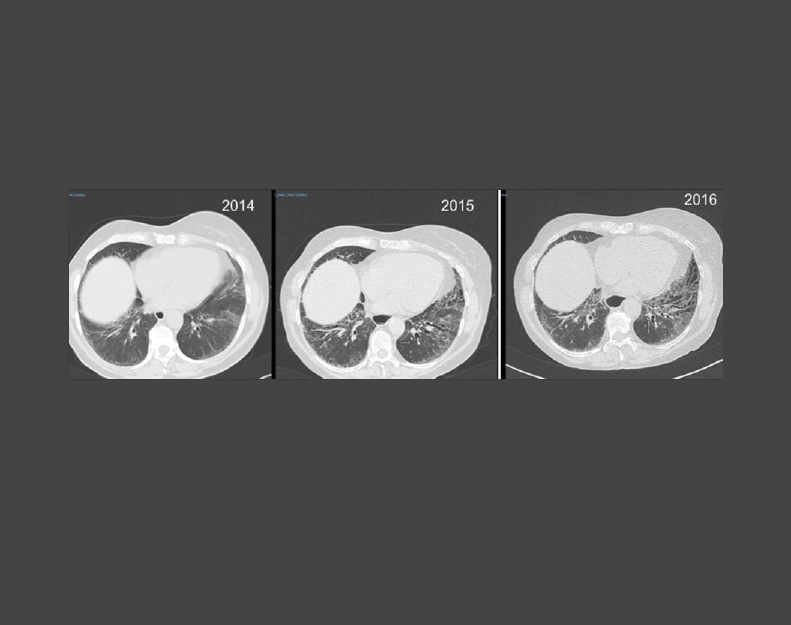
In an international collaborative study coordinated by Professor Yannick Allanore, more than 300 patients with systemic sclerosis underwent blood analysis to identify early plasma biomarkers of interstitial lung disease (ILD).
Working in collaboration with the Institut Cochin Proteomics Platform, researchers analyzed more than 1,500 plasma proteins and identified two promising biomarkers: surfactant protein D (SP-D), whose elevated levels are associated with the presence of pulmonary fibrosis, and matrix metalloproteinase-8 (MMP-8), whose high levels predict an increased risk of lung fibrosis progression within the following two years.
Validated across several independent cohorts spanning three continents, these findings pave the way for the development of blood tests capable of identifying high-risk patients at an earlier stage and tailoring their clinical management accordingly. However, larger validation studies will still be required before these biomarkers can be implemented in routine clinical practice.
Systemic sclerosis is a rare autoimmune disease characterized by abnormal skin thickening that can also affect several internal organs. Among its most serious complications is interstitial lung disease (ILD), a form of pulmonary fibrosis that affects approximately one in two patients and is currently the leading cause of disease-related mortality. In some patients, this fibrosis progresses rapidly, causing irreversible deterioration of lung function—a condition referred to as progressive pulmonary fibrosis (PPF).
One of the major clinical challenges is determining, at the time of diagnosis, which patients will experience worsening lung disease and which will remain stable. Although immunosuppressive and antifibrotic therapies are available, their optimal use depends on the early identification of patients at greatest risk. This is where blood biomarkers could play a critical role by identifying patients who require closer monitoring even before clinical symptoms worsen.
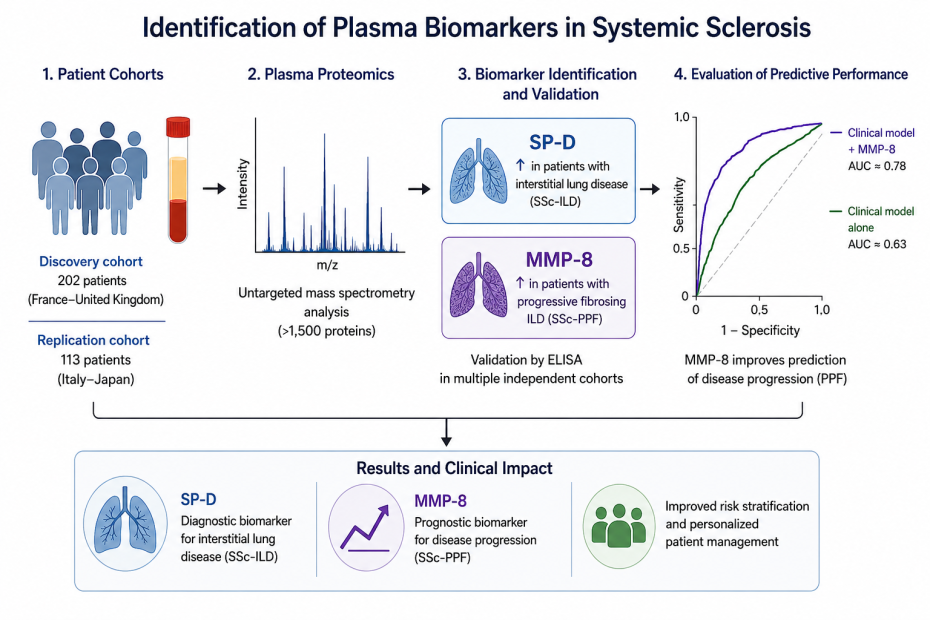
To identify such biomarkers, the investigators adopted an unbiased proteomics approach,
analyzing the entire repertoire of proteins present in the blood of patients with systemic sclerosis using high-throughput mass spectrometry, without any prior assumptions.
The study included a total of 315 patients recruited across five centers. It comprised a discovery cohort of 45 patients from Paris, in whom proteomic analysis screened more than 1,500 circulating proteins; a first replication cohort of 157 patients from Paris, Bordeaux, and Leeds, designed to confirm the initial findings; and a second replication cohort of 113 patients from Milan and Tokyo, established to validate the robustness of the results at an international level.
Among the proteins detected, 44 were associated with the presence of interstitial lung disease, while 51 were associated with disease progression. Following a rigorous selection process, 14 candidate proteins were retained for validation. Ultimately, two proteins emerged as particularly robust biomarkers.
Surfactant protein D (SP-D), already recognized as a marker of lung epithelial cell injury, was found at significantly higher levels in patients with interstitial lung disease than in those without pulmonary involvement. These findings suggest that SP-D may serve as a valuable diagnostic biomarker for the presence of pulmonary fibrosis.
Matrix metalloproteinase-8 (MMP-8), an enzyme produced primarily by white blood cells and involved in extracellular matrix degradation, emerged as a marker of disease progression. Blood concentrations of MMP-8 were consistently higher in patients whose lung disease worsened compared with those whose condition remained stable.
These results suggest that measuring SP-D in blood could ultimately help identify pulmonary involvement in patients with systemic sclerosis, while MMP-8 could serve as a prognostic biomarker to predict future disease progression. Combined with existing clinical parameters, these biomarkers could contribute to a more personalized approach to patient care by identifying, at an earlier stage, individuals who would benefit from intensified monitoring or therapeutic adjustment, particularly as new antifibrotic therapies become available.
This research therefore represents an important step toward the development of simple blood-based tools to improve the management of patients living with this rare disease. Nevertheless, the authors emphasize that larger studies with comprehensive clinical validation will be required before these biomarkers can be adopted in routine clinical practice.
Find out more
High-throughput plasma proteomics reveals circulating biomarkers of interstitial lung disease and progressive pulmonary fibrosis in systemic sclerosis.
Elias Gerges, Anne Cauvet, Margot Guedot, Mélodie Dahan, Mathieu Mairet , Jérôme Avouac, Camille Gobeaux, Emilie-Fleur Gautier, Morgane Le Gall, Guilhem Clary, Louis Bébéar, Marie-Elise Truchetet, Panji Mulipa, Costanza Monterosso, Rebecca L. Ross, Masataka Kuwana, Yuichiro Shirai, Raffaella Molteni, Corrado Campochiaro, Marco Matucci-Cerinic, Claudia Iannone, Francesco Del Galdo, and Yannick Allanore*.
* Corresponding author: Pr Yannick Allanore (yannick.allanore@aphp.fr)


