Cystic fibrosis: the contrasting effects of new treatments on innate immunity
Cystic fibrosis is a genetic disease that leads to thick mucus in the lungs, promoting chronic infections and damaging inflammation. Neutrophils, the immune cells that are supposed to fight infection, are both too numerous and dysfunctional in patients: they struggle to clear bacteria while sustaining the inflammation that gradually destroys lung tissue. In recent years, so-called “CFTR modulator” treatments, including the triple therapy elexacaftor-tezacaftor-ivacaftor (ETI; brand name: Kaftrio), have partially corrected the defective protein CFTR and markedly improved respiratory function. However, their precise effects on neutrophils remained poorly understood.
The researchers used a cutting-edge technique, spectral flow cytometry, to simultaneously measure 24 surface markers on neutrophils from 24 healthy donors and 45 adults with cystic fibrosis, before and after ETI treatment. This approach enabled them to draw a very fine “identity map” of these cells and to identify distinct subgroups within the neutrophil population, instead of viewing these cells as a uniform population.
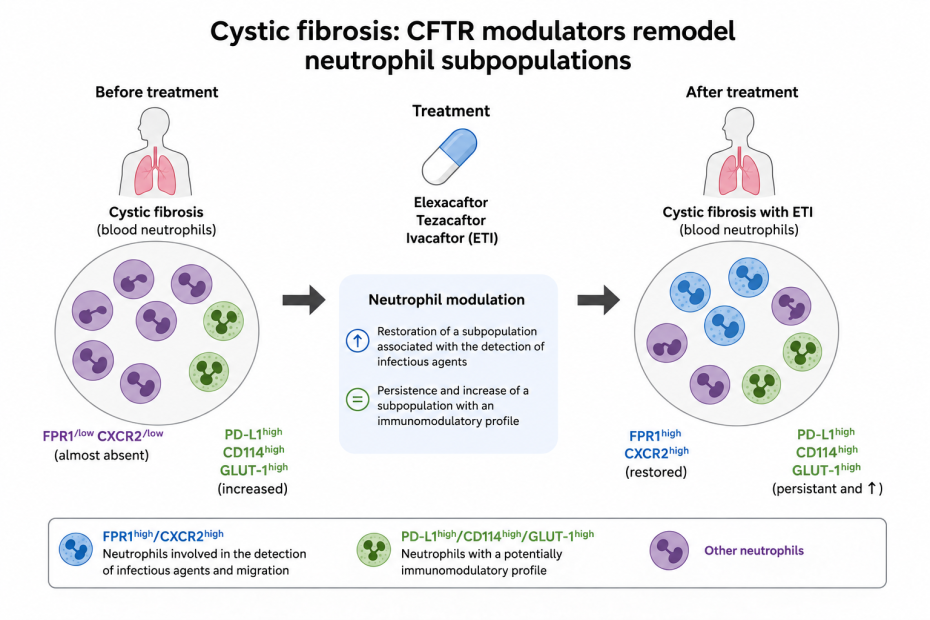
The results show that, before treatment, patients’ neutrophils display a distinctive profile marked by signs of immune activation and metabolic abnormalities, different from that of healthy donors. ETI restores a neutrophil subset carrying two receptors (FPR1 and CXCR2) involved in detecting infectious agents and migrating to sites of infection -an encouraging sign, consistent with improved antimicrobial defence. This subset is restored to a greater extent as CFTR protein function improves, as measured by the sweat test.
Conversely, the treatment promotes the emergence of another subset of mature neutrophils expressing higher levels of PD-L1, a molecule known to dampen T-cell immune responses, as well as metabolic markers (GLUT-1, CD114) and adhesion markers (CD11b, CD11c). According to the authors, this subset could potentially hinder certain immune defences rather than strengthen them. In other words, ETI does not simply “repair” neutrophils: it reshapes their profiles, improving some antimicrobial functions while also possibly favoring a profile that could “weaken” the immune response.
The researchers remain cautious: although they have characterized neutrophil phenotype, they have not directly tested their actual functions, such as their ability to kill bacteria or their degree of immunosuppression. Moreover, the data concern blood neutrophils, not those in the lungs; the behavior of these cells once recruited into inflamed airways may differ. Finally, the exact mechanism by which ETI acts on neutrophils remains to be elucidated: it is not yet clear whether this is a direct effect on CFTR in these cells or an indirect effect linked to the overall improvement in patients’ health, nor whether these modulations are sustained or transient.
In conclusion, this study paves the way for complementary (“adjuvant”) treatments in cystic fibrosis that would specifically aim to enhance neutrophil subsets useful for defence against infection, while limiting the expansion of subsets with immunosuppressive tendencies.
Learn more:
CFTR modulators exert subset-specific phenotype remodeling on circulating neutrophils in cystic fibrosis.
Chable de la Héronnière F, Dhôte T, de Oliveira Formiga R, Regard L, Saraceni-Tasso G, Andrieu M, Many S, Da Silva J, Pène F, Martin C, Ladjemi MZ, Burgel PR, Witko-Sarsat V. Immunohorizons. 2026 Jul 10;10(7)