Towards new microbiota-based strategies
The gut harbours the largest microbial population in the human body: the gut microbiota. This complex ecosystem plays an essential role in our health and notably helps protect the body against colonisation by potentially harmful bacteria. When the microbiota is disrupted, this protective effect can be impaired. Yet even in individuals with a healthy gut microbiota, new bacteria can still become established. “The precise mechanisms underlying this phenomenon are still poorly understood. One difficulty is that each individual has a specific microbiota, which may lead to different responses,” explains Hugo Barreto, principal investigator of the MICROINVADER project in the team of O. Tenaillon and I. Matic at Institut Cochin.
This project specifically aims to understand how interindividual variations in the microbiota influence the dynamics of bacterial invasion and colonisation. Escherichia coli (E. coli) is a bacterium capable of colonising many environments, including the human gut. It displays very high genetic diversity. Some strains live in our gut as so-called “commensal” bacteria without causing disease, whereas others can become pathogenic. In the human gut, E. coli can also evolve rapidly. Even in healthy people, new strains can replace strains that are already present: a phenomenon known as strain replacement.
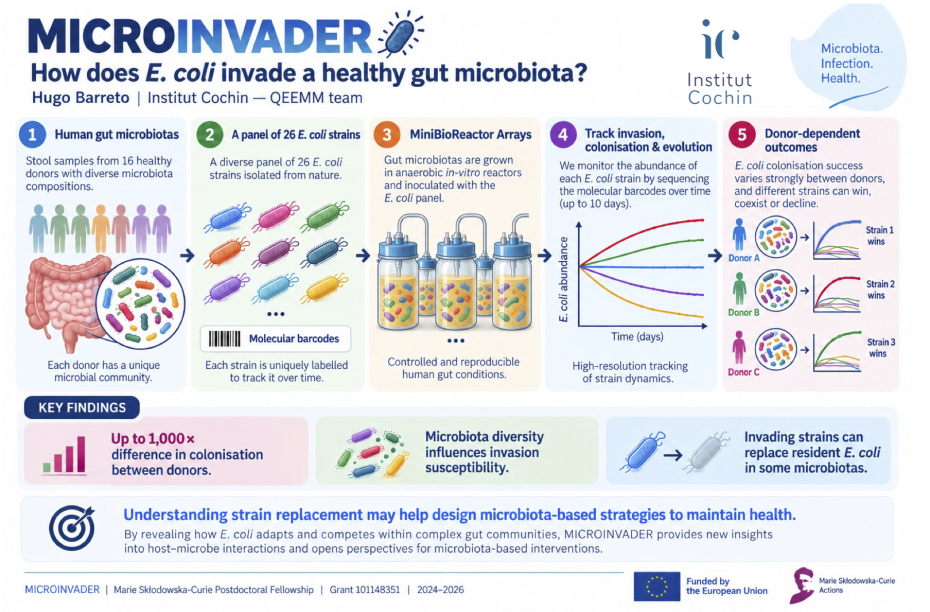
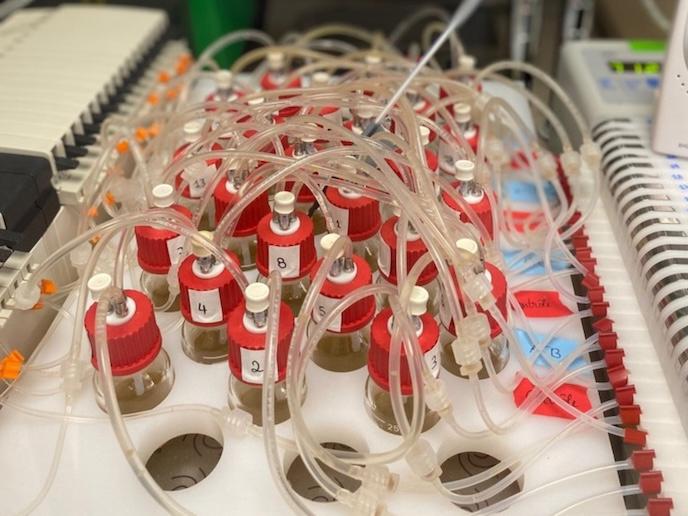
To understand this process, the researchers took advantage of a particularly useful property of E. coli: its ease of genetic manipulation. They assigned specific “molecular barcodes” to different natural strains previously isolated from humans. These signatures make it possible to track the different strains simultaneously and identify those that successfully invade and then colonise a given gut microbiota. As part of the MICROINVADER project, the researchers selected 16 human gut microbiotas from the NutriNet-Santé cohort. These microbiotas were cultured in MiniBioReactors (MBRAs) inside an anaerobic chamber reproducing the oxygen-free conditions of the gut. In these minireactors, researchers can introduce different E. coli strains, collect samples regularly and monitor their evolution without the behavioural and physiological variations inherent to a living organism.
After a few days of adaptation, a panel of 26 natural E. coli isolates, each carrying a molecular barcode, was introduced into the microbiotas. The abundance of the different strains and the evolution of their barcodes were then monitored over time. Importantly, the selected microbiotas already contained one or more resident E. coli strains. The scientists were therefore able to observe in real time whether the new strains could coexist with the resident bacteria or replace them. To also investigate the evolution of colonising strains in a living organism, eight human microbiotas from this experiment were subsequently transplanted into germ-free mice, which initially lacked a microbiota. Their evolution was monitored for two months.
The results reveal very strong variability in the ability of E. coli to invade and colonise the different human gut microbiotas: colonisation levels can vary by a factor of 1,000. The identity of the E. coli strain that becomes dominant after invasion also depends on the donor microbiota. This variability is partly explained by the diversity of the human gut microbiota and by genetic differences between E. coli populations. However, the researchers also observed another phenomenon: the dominant invading strain can evolve rapidly during colonisation, thereby altering the dynamics of invasion. Experiments in mice, for which analyses are still ongoing, also show that some human microbiotas can limit E. coli abundance by a factor of 100.
One of the most striking findings concerns strain replacement. In all the human gut microbiotas tested, the resident E. coli strains were ultimately replaced. This observation contrasts with previous studies in which a single strain was generally introduced and often failed to colonise the microbiota. “This suggests that strain replacement results from both the diversity of the invading bacteria and the composition of the human gut microbiota,” emphasises Hugo Barreto. These findings therefore show that a bacterium’s ability to colonise the gut does not depend solely on its own characteristics: it results from a complex interaction between the diversity of bacterial candidates for colonisation, the composition of the microbiota already present, and the ability of new strains to evolve rapidly.
A better understanding of the mechanisms governing bacterial strain replacement in a healthy gut could open up new therapeutic opportunities. In the longer term, this knowledge could notably make it possible to develop strategies aimed at modifying or strengthening the gut microbiota in order to prevent the establishment of undesirable bacteria or promote beneficial bacteria. It could also help optimise microbiota-based therapeutic approaches, such as faecal microbiota transplantation.
To know more about
https://cordis.europa.eu/article/id/467317-how-e-coli-invades-and-colonises-healthy-human-gut-microbiotas)
Projet MICROINVADER - Projet soutenu dans le cadre des Actions Marie Skłodowska-Curie (MSCA).