

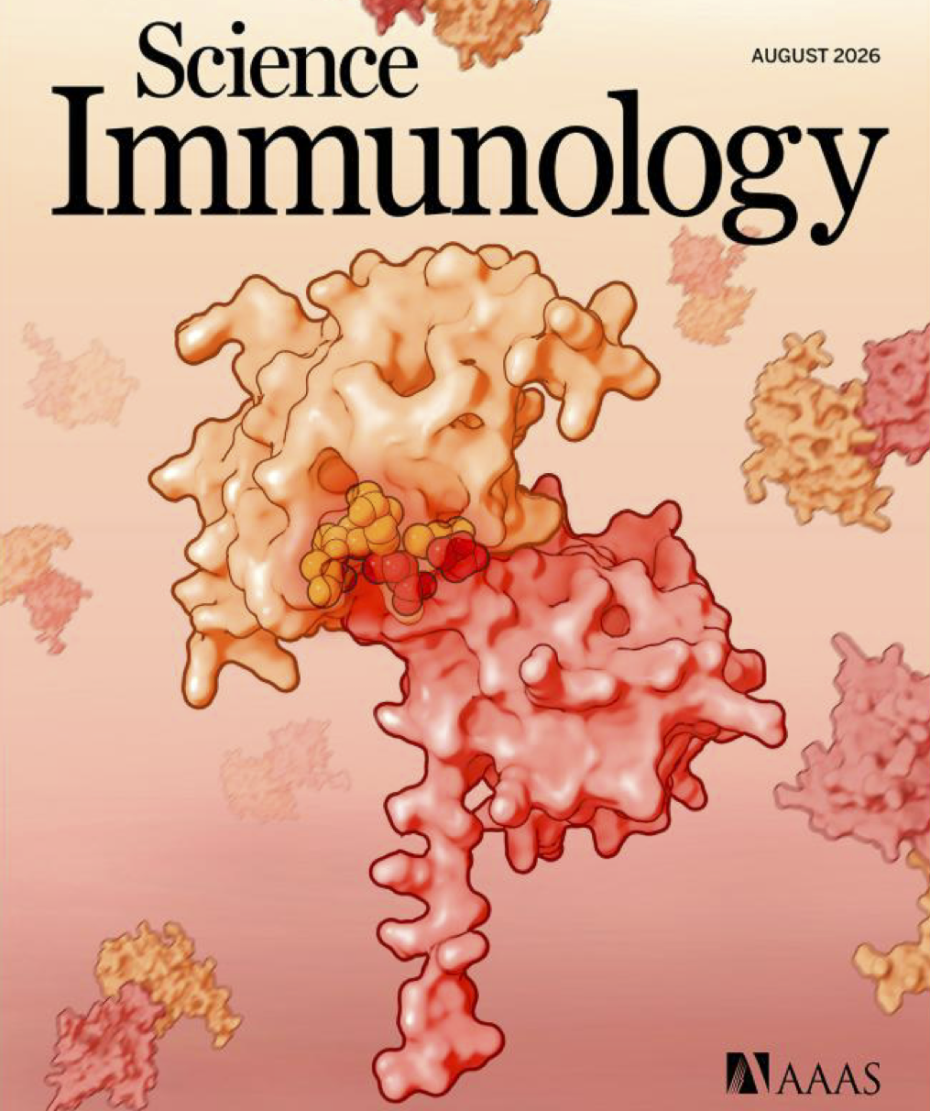
A hyperactivating variant of pyrin
CDC42 is a small GTPase of the RHO family that regulates, among other processes, actin cytoskeleton polymerization. Patients carrying the newly identified p.T43I variant develop inflammasome-dependent inflammation, which responds to IL-1 inhibitors.
Structural analyses, combining artificial intelligence-based modelling and molecular dynamics simulations, show that this region of CDC42 directly interacts with the B30.2 domain of pyrin. The T43I substitution strengthens this interaction through new physicochemical contacts, resulting in excessive activation of the pyrin inflammasome, increased pyroptotic cell death, and excessive production of IL-1β and IL-18.
This new variant acts independently of the CDC42 R186C variant previously described by the same team, which notably activates the type I interferon pathway while remaining abnormally sequestered in the Golgi apparatus. In contrast, T43I does not alter the cytosolic localization of CDC42: it is the strengthened interaction with pyrin itself that explains the hyperinflammation.
Figure 1: Structural modelling of the pyrin–CDC42 interface by molecular dynamics. Pyrin is shown in purple, while CDC42 is shown in green (WT) and cyan (T43I variant). The enlarged view of the interface highlights residue 43 (red) and its interaction network with pyrin. Replacing threonine (T43, WT) with isoleucine (I43, variant) introduces additional contacts, including hydrophobic van der Waals interactions, thereby stabilizing the CDC42–pyrin interaction.
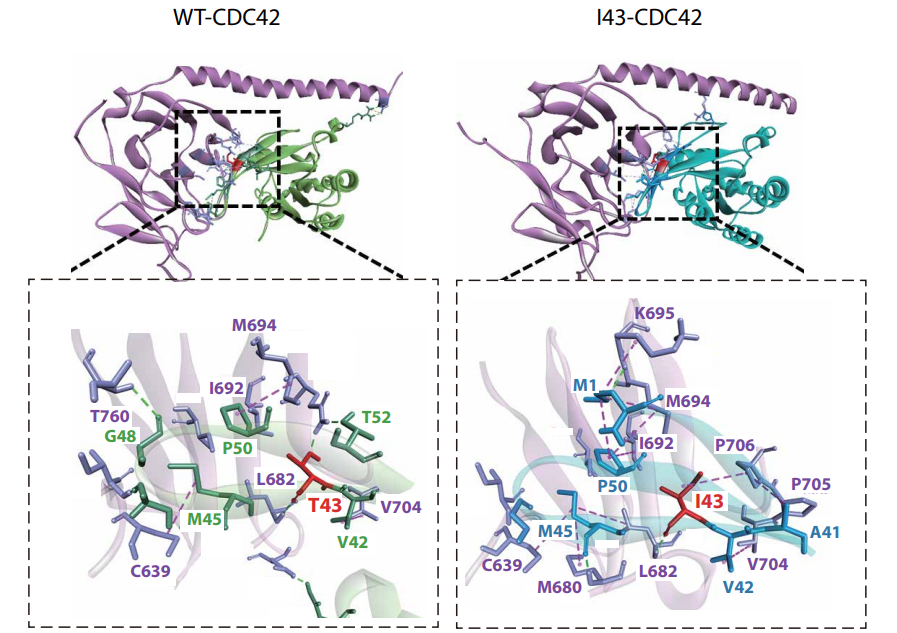
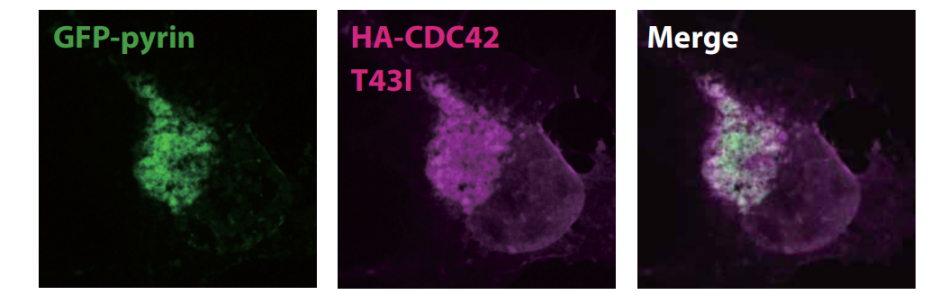
Figure 2 : Subcellular localization of pyrin and CDC42 T43I by immunofluorescence in transfected COS-1 cells. Their overlap shows that the two proteins are co-localized within the same cellular compartment, consistent with the direct interaction demonstrated by structural and biochemical analyses.
From rare diseases to a better understanding of fundamental mechanisms and applications to more common diseases
Beyond the six patients affected, these findings illustrate a broader principle: studying a rare genetic disease has enabled the identification of CDC42 as the long-sought activating ligand of the B30.2 domain of pyrin.
This work also provides new insight into mechanisms involved in much more common diseases. By mapping the interface between CDC42 and the B30.2 domain of pyrin, the authors explain the patients’ phenotype while providing a framework that can be directly applied to FMF, which affects approximately 100,000 people worldwide.
Two of the most common pyrin variants responsible for FMF are located in close proximity to this same interface. Other work published in the same issue of the journal shows that these variants also act by increasing the affinity of pyrin for CDC42. Thus, the mechanism identified in a handful of patients carrying an ultra-rare CDC42 variant may also operate in tens of thousands of patients with the classical form of FMF.
This convergence positions CDC42 as a potential common therapeutic target for several diseases associated with pyrin hyperactivation, whether caused by variants in pyrin itself or, more rarely, in CDC42. It also highlights the value of internationally coordinated rare-disease cohorts as an entry point for understanding and ultimately treating much more common inflammatory diseases.
Reference:
*Aoki M, *Iannuzzo A, *Mertz P, Feng S, Iwata N, Perugini C, Tsuchida N, El Masri R, Kuchitsu Y, Tacine R, Coppola S, Shibata H, Cescato M, Nishitani-Isa M, Terré A, Kawasaki Y, Dalmon S, Nishimura K, Magnotti F, Miyatake S, André M, Hamada K, London J, Izawa K, Niwa A, Okamoto N, Ogata K, Nishikawa M, Zara E, Saito MK, Tartaglia M, Ito S, Rodero MP, Nagata KI, Smahi A, Matsumoto N, Le Corre L, Takita J, Boursier G, Hijikata A, Henry T, Taguchi T, Hentgen V, Georgin-Lavialle S, Honda Y, Masters SL, #Yasumi T, #Delon J. An N-terminal CDC42 T43I variant reveals the mechanism of pyrin inflammasome activation. Science Immunology, 2026 Aug 7;11(122):eaea0515. doi: 10.1126/sciimmunol.aea0515. Epub 2026 Aug 7. PMID: 42566498.


