
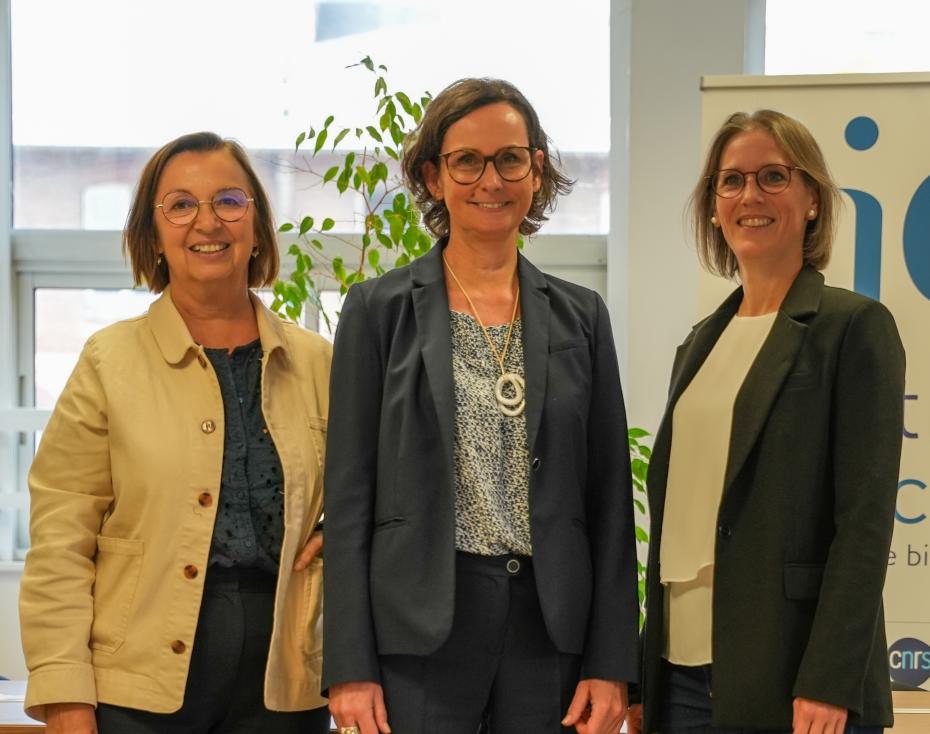

Florence Niedergang, director
Florence Niedergang is an internationally recognized expert in the field of phagocytosis. She heads the "Biology of Phagocytes, Infection and Immunity" team.
Florence Niedergang studied biochemistry and immunology at ENS Cachan and Paris Diderot University. She obtained her PhD in 1997 for studies on the activation of T lymphocytes at Institut Pasteur. With the financial support of the ARC and EMBO foundations, she is doing a post-doctorate at the University of Lausanne (Switzerland) where she is studying the role of dendritic cells and macrophages in the absorption and survival of bacteria in the intestine. In 2001, she was recruited as a CNRS research fellow at Institut Curie to dissect the molecular mechanisms of phagocytosis in macrophages. In 2005, she joined Institut Cochin as group leader, funded by emergence programs from the CNRS (ATIP) and the City of Paris. His team is interested in the mechanisms of clearance and activation of phagocytic cells, both under normal and pathological conditions such as viral infections.
Florence Niedergang is the author of 67 publications, 6 book chapters and 3 patents. She is a member of the scientific council of the Institute of Biological Sciences of the CNRS (INSB), co-coordinator of the Paris Center Node of the national infrastructure France BioImaging, co-director of the GDR AQV ('Quantitative Approaches to Life'), co -director of Microb'UP, "Institut Hors Murs Microbiologie", Université Paris Cité and president of the French Society of Cellular Biology (SBCF).
In 2017, she was elected director of the "Infection, Immunity and Inflammation" department. In 2022, she was appointed director of Institut Cochin.

Catherine Postic, deputy director
Catherine Postic is a research director at CNRS.
Catherine Postic obtained her doctorate in Physiology and Physiopathology from the Université Paris Diderot in 1993. She completed her thesis in the laboratory of Professor Jean Girard, where she became familiar with metabolism and physiology. In 1993, she joined Dr Marc Magnuson's laboratory at Vanderbilt University (Nashville, USA) where she created a conditional locus, via the Cre-LoxP system, for the glucokinase gene, a key enzyme in carbohydrate metabolism. Using this approach, she explored the specific function of glucokinase in pancreatic ß cells and hepatocytes and demonstrated its importance in glucose detection. She was recruited as a CNRS research fellow in 2000. Her research aims to study the role of the liver in controlling energy homeostasis and to understand, in particular, the molecular mechanisms involved in the pathophysiology of metabolic liver diseases. Since 2014, she has co-directed the ‘Glucose and Insulin Signalling, Glucotoxicity’ team with Tarik Issad.
Winner of several awards, including the CNRS silver medal in 2015, Catherine Postic is the author of more than 110 articles, several book chapters, editorials and review articles. For several years she has been a member of the editorial board of scientific journals (J HEP Reports, Cell Reports, J Clin Investigation). She was appointed a member of the INSERM Specialised Scientific Committee (CSS) 3 from 2012 to 2016, the Scientific Council of the Fondation pour la Recherche Médicale from 2018 to 2022 and the Physiology, Ageing and Tumorigenesis Section of the CNRS from 2021 to 2025. In 2024, she became President of the Scientific Council of the Société Francophone du Diabète.
From 2022 to 2024, Catherine Postic co-directed the Endocrinology and Metabolism Axis with Ralf Jockers. In 2025, she became Deputy Director of the Institut Cochin.

Noémie Marrant, general secretary
Noémie Marrant has dual expertise in human resources and administration management. She has built her career within hospital structures and in the academic research world.
Noémie Marrant holds a master's degree in economic and social administration, "human resources" option, and a DESS in "executives for social sector organizations" from the University of Paris-Panthéon-Sorbonne. After beginning her career in 2006 at Bicêtre Hospital, where she was assistant to the HRD and then pole administrative manager, she discovered the world of research by joining the ANRS in 2009. Subsequently, she served as head of human resources for medical staff at the Maison Blanche hospital (GHU Paris psychiatry and neurosciences) before becoming General Secretary of Institut Cochin.


